Craftax
Craftax is a survival and crafting environment. Craftax Classic contains the original single-world survival game. Full Craftax adds nine floors, dungeons, equipment, elemental combat, spells, potions, and a final boss.
EnvPool implements both games and their renderers in C++. The reference is
Craftax v1.6.1, commit c3c2e0d038c4e641f9481320c158f457f30c28f3.
Craftax, JAX, and Flax are not runtime dependencies. The extension embeds only
PNG textures referenced by the official renderer; no Python game code or
training assets are loaded at runtime. The upstream MIT license is included
in the wheel.
Environments
Name |
Actions |
Observation shape |
Time limit |
|---|---|---|---|
|
17 |
|
10,000 |
|
17 |
|
10,000 |
|
43 |
|
100,000 |
|
43 |
|
100,000 |
All observations are float32. Pixel observations use the official
normalization to [0, 1] and include the inventory display. Symbolic
observations contain the local map, entities, inventory, and player status.
The declared symbolic bounds follow upstream; some equipment and status
features can exceed one during play.
Each name also has the official -AutoReset-v1 variant, for example
Craftax-Symbolic-AutoReset-v1. Every name has a Craftax/ alias:
Craftax/Symbolic-v1 and Craftax/Classic-Pixels-v1 are examples.
The registry is generated from the pinned upstream factory.
Usage
import envpool
import numpy as np

env = envpool.make_gymnasium(
    "Craftax-Symbolic-v1",
    num_envs=32,
    seed=0,
    render_mode="rgb_array",
)
obs, info = env.reset()
actions = np.zeros(32, dtype=np.int32)
obs, reward, terminated, truncated, info = env.step(actions)
frames = env.render(env_ids=[0, 3])
env.close()
Reset and termination
Primary names use EnvPool’s usual reset on the step after an episode ends.
That step returns the new initial observation, zero reward, and a first
dm_env timestep; its submitted action is not applied.
The AutoReset names reset on the terminal step itself, as the official
Craftax wrapper does. They return the new initial observation with the old
episode’s reward, terminal flag, and achievement information. The next action
is applied to the new episode. Rendering after that step shows the new state.
These names advertise SameStep in Gymnasium’s autoreset metadata.
Death, Classic lava, and full-game boss victory are terminations. A time
limit without a simultaneous game termination is a truncation. The discount
is zero at either boundary, matching the official oracle, including in the
dm_env API. info["discount"] retains that same value.
Achievement information uses the official Achievements/<name> keys and
reports 100 for an earned achievement only at the episode boundary. Classic
also returns the official geometric-mean score. In dm_env namedtuples,
the usual EnvPool conversion replaces slashes in field names with underscores.
Configuration and reproducibility
max_episode_steps sets upstream max_timesteps. Both games accept
day_length, always_diamond, mob_despawn_distance, entity capacities,
and fractal_noise_angles. Classic uses the shared capacity names
max_melee_mobs, max_passive_mobs, max_ranged_mobs, and
max_mob_projectiles for zombies, cows, skeletons, and arrows respectively.
Classic also accepts the official mob health and spawn chance parameters.
god_mode and max_attribute apply to the full game.
map_size defaults to (64, 64) for Classic and (48, 48) for the full
game. Maps must be square with a size divisible by 16, at least 16 for Classic
and 48 for full Craftax’s eight-room dungeon generator. The number of floors
is fixed at one and nine respectively. Noise overrides are four flattened
arrays in upstream order; an empty array selects random angles for that layer.
Random draws use a native Threefry2x32 implementation with the pinned JAX
partitionable counter layout. Each environment starts with
PRNGKey(seed + env_id) (or its explicit env_seed). The first reset uses
that key directly. Each following step splits the stream, keeps the left key,
and uses the right key for the step or the next-step reset. The AutoReset
wrapper further splits its step key into the official step and reset keys.
Identical seeds and external actions therefore reproduce whole episodes,
independently of thread count.
Full Craftax’s symbolic reset splits its input key once more than pixel reset, matching the official implementation. Consequently, the two observation variants can generate different worlds from the same external seed.
Rendering
render() produces batched uint8 RGB frames. With the default
render_tile_size=16, Classic frames are (144, 144, 3) and full Craftax
frames are (208, 176, 3). render_tile_size=64 selects the official human
texture resolution. The standard render_width and render_height
options resize the resulting frame by nearest-neighbor sampling.
The renderer includes the official sprites, inventory digits, projectiles, light and night effects, sleep shading, and full-game floor visibility.
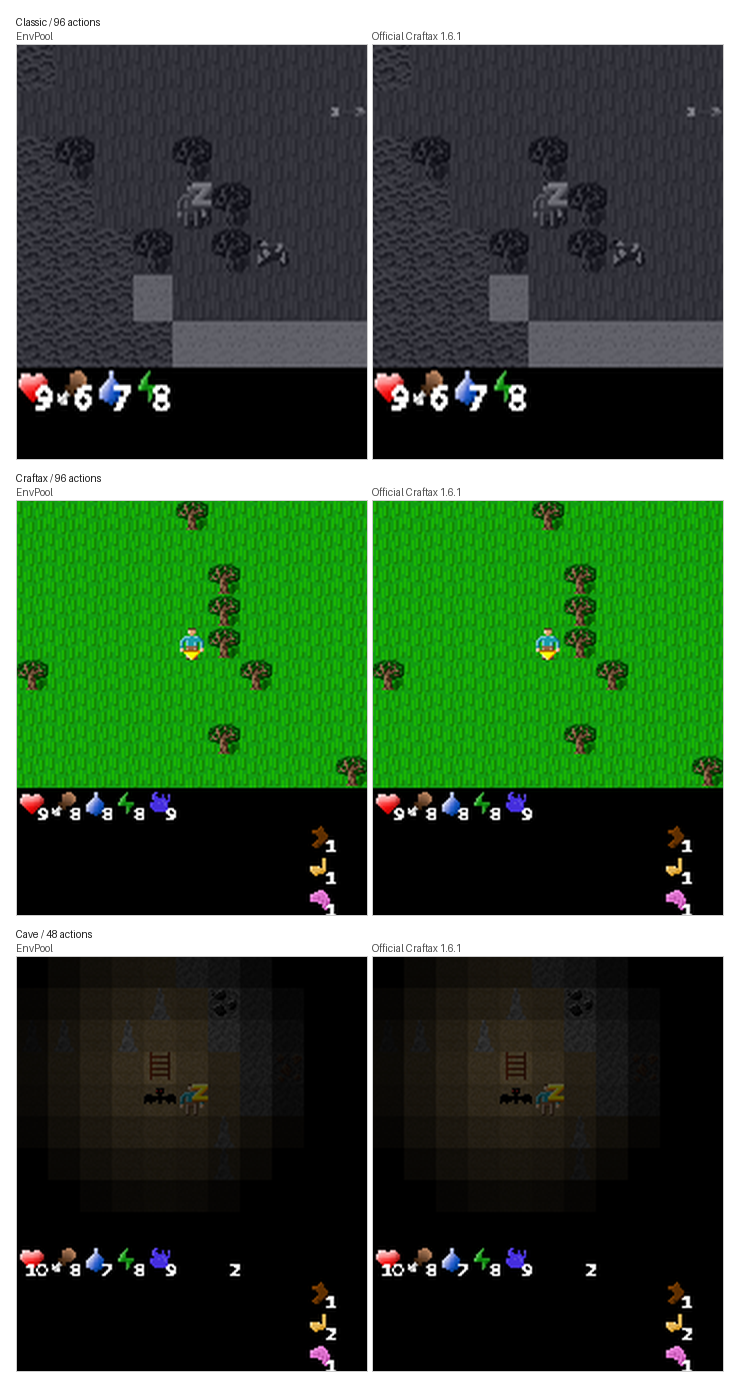
EnvPool is on the left and the pinned official renderer is on the right. The documentation generator checks exact RGB equality after each displayed action sequence before writing the comparison image.
Regenerate it with the shared documentation tool:
bazel run --config=test //scripts:render_compare -- \
  --family=craftax --seed=11 --columns=1 --require-bitwise \
  --tile-width=352 --tile-height=416
Validation
Oracle tests use the pinned source and a separate dependency lock, including JAX/JAXlib 0.11.1 and Flax 0.12.9. They exercise all factory names, whole trajectories, crafting and resource interactions, every floor’s combat, projectiles, potion and enchantment actions, plants, boss waves, and victory. The official texture cache is a test-only build artifact and is never shipped as a runtime dependency.
Directed tests inject state only once, before the first external action.
The initial_state configuration supports the same reset-only exchange
through the actual pool; debug_state=True exposes its diagnostic encoding
in info["state"]. Neither option provides a mid-episode synchronization
path. The diagnostic encoding is not a stable saved-game format.
Native float RGB agrees bitwise with the standalone official renderer. JAX changes the final daylight blend’s fused multiply-add operand order when compiling some combined reset/step graphs. Reversing just that operation reproduces the residual, including its propagation through sleep’s grayscale. The observation tests allow only these demonstrated exceptions:
ARM64 (macOS and Linux), Classic reset/non-AutoReset step: map blue in four-pixel vector blocks (columns 0–59), one ULP at reset and two during steps. While sleeping, the same region’s RGB channels allow two ULPs.
x86-64 (Linux and Windows), Classic AutoReset step: map red, up to two ULPs; while sleeping, map green/blue in columns 0–55 have the same bound.
x86-64, full-game reset: map red/green in eight-pixel vector blocks (columns 0–103), one ULP.
Inventory, all other channels and scalar tails, symbolic observations, game state, rewards, information, and rendered uint8 RGB frames remain exact. There is no general observation or gameplay tolerance.